Skin Health Over 40
June 24, 2026

Skin Health Over 40
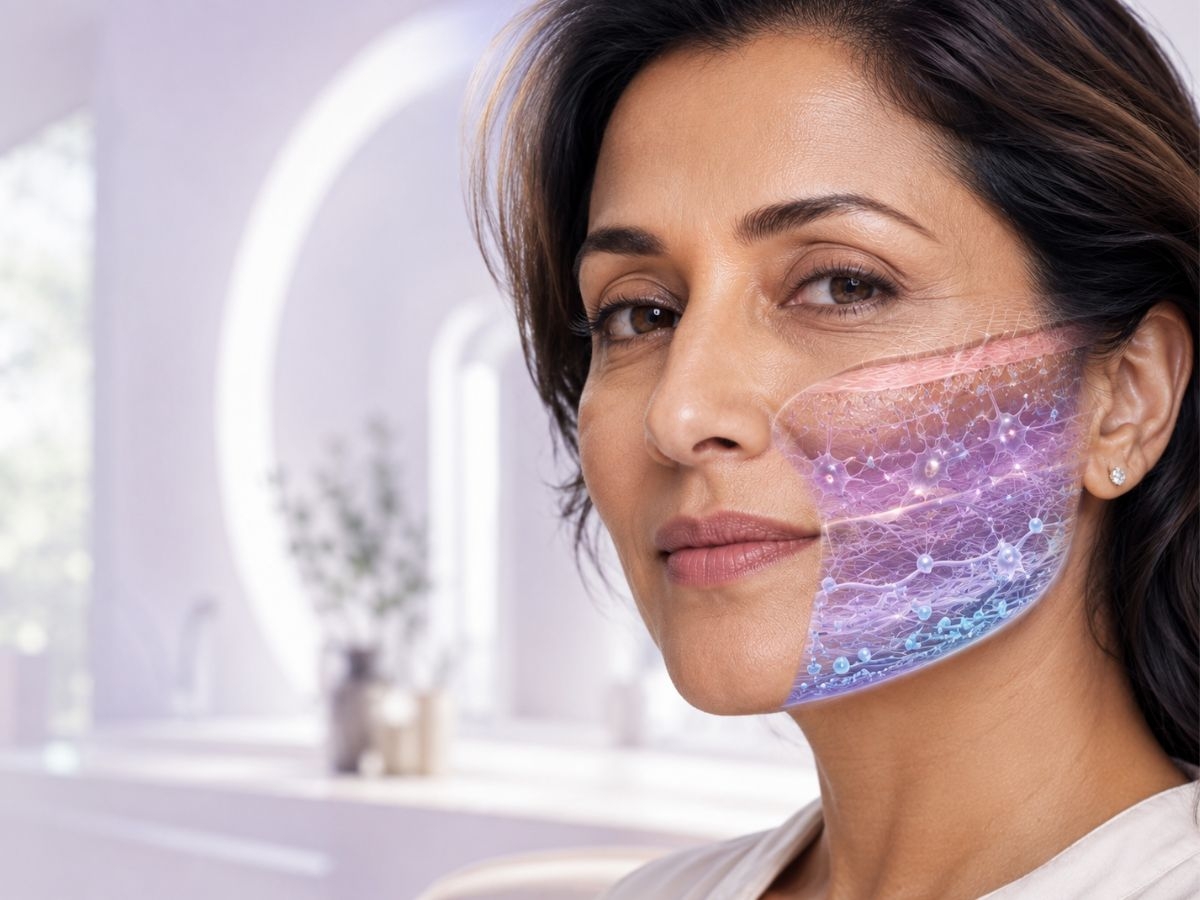
A regenerative approach to the skin changes that begin in your 40s and accelerate through your 50s and 60s — addressing the biological drivers of dermal aging, not just the surface.
At a Glance
What it targets: The biological drivers of visible aging from 40 onward — declining collagen and elastin, reduced dermal turnover, oxidative damage, hormonal shifts, and loss of dermal vascularity.
Who it’s for: Adults over 40 noticing meaningful changes in firmness, elasticity, texture, or tone — seeking a regenerative approach beyond topical-only or aesthetic-procedure-only.
How it works: GHK-Cu peptide for dermal regeneration, exosome therapy for cellular repair signalling, optional add-on peptides (BPC-157, Tα1, SS-31), hormonal support where indicated, plus the lifestyle layer that determines outcomes.
What to expect: Texture, hydration, and tone often shift first. Firmness and elasticity follow over the building phase. Structural dermal change is the longest arc and rewards consistency.
Who This Protocol Is For
Something changes in your 40s. The skin you had at 28 — the one that bounced back, healed fast, looked rested on four hours of sleep — is quietly being replaced by skin that doesn’t. Topical products plateau. Surface procedures don’t address why the underlying skin is changing. Many of our clients are specifically researching anti-aging skin treatment, exosome facial, PRP facial, GFC facial, skin tightening, or regenerative alternatives to Botox and fillers in India — and want a clinically grounded protocol rather than one-off salon procedures. The biology is real: collagen synthesis declines, elastin degrades faster than it’s replaced, dermal blood supply diminishes, and from perimenopause onward, hormonal shifts accelerate the process.
This protocol was built for you if:
Loss of firmness, fine lines, or texture changes topical products aren’t solving
Perimenopausal or menopausal skin changes — thinning, dryness, pigmentation shifts, loss of glow
Reduced healing speed — minor cuts and irritations take longer to resolve
Cumulative Indian sun damage showing up as pigmentation, uneven tone, or texture
Want to avoid or reduce reliance on Botox, fillers, or invasive procedures
Already invest in aesthetic dermatology and want a biological layer that makes those treatments work better
Men over 40 wanting to address visible aging without the aesthetic-procedure pathway
How It Works — The ALIV Approach
Skin aging is the intersection of declining collagen and elastin production, cumulative oxidative damage, reduced dermal vascularity, hormonal shifts, and the slow loss of stem cell populations. The protocol works at this biological level.
Layer 1 — Dermal Regeneration: GHK-Cu and Exosome Therapy
GHK-Cu is a copper-binding tripeptide naturally occurring in human plasma. With age, GHK levels drop substantially. GHK-Cu modulates the expression of thousands of genes involved in collagen production, antioxidant defence, and tissue regeneration. Topical GHK-Cu in nano-carriers has demonstrated significant reductions in facial wrinkle volume and depth in published trials.
Exosome therapy — ALIV’s core regenerative skin offering — delivers nanoscale vesicles carrying peptides, growth factors, and signalling molecules that activate dermal fibroblasts and stem cells. Compared to traditional PRP and GFC (growth factor concentrate) facials, exosomes carry a denser, more standardised payload. A 2023 split-face RCT showed adipose-derived exosomes with microneedling produced significantly better hydration, elasticity, and pigmentation than microneedling alone; a 2024 systematic review found increased collagen deposition. Not FDA-approved; evidence early but accumulating.
Potential Peptide Add-Ons
Depending on your clinical picture and goals, additional peptides may be layered in.
BPC-157 — substantial preclinical evidence in skin: wound healing, fibroblast and collagen activity, angiogenesis. Particularly for slow healing, post-procedural recovery, or scar remodelling.
Thymosin Alpha-1 — skin is an immune organ; ‘inflammaging’ drives much dermal aging. Tα1 modulates immunity and reduces chronic inflammation. Particularly for reactive or inflamed skin.
SS-31 (Elamipretide) — dermal fibroblasts depend on mitochondrial function. SS-31 binds cardiolipin, reducing ROS that drive photoaging. Mechanism well-established; Phase 3 trials in non-skin indications mixed.
Layer 2 — Hormonal and Systemic Drivers
Skin is exquisitely sensitive to hormonal state. Oestrogen decline drives much of the perimenopausal transition — thinning, reduced collagen, slower healing. Where hormonal drivers are present — in most clients over 40, they are — this layer coordinates with ALIV’s Perimenopause Protocol or appropriate male hormonal optimisation.
Layer 3 — Diagnostic Precision
Your ALIV physician runs a comprehensive workup — clinical skin examination, hormonal profile (oestrogen, progesterone, testosterone, DHEA, thyroid), inflammatory markers, micronutrient status (zinc, vitamin D, ferritin), and screening for dermatological conditions requiring specialist management.
What to Expect
Skin remodelling is multi-phase. Epidermal changes — texture, hydration, tone — appear first because the epidermis turns over quickly. Dermal changes — firmness, elasticity, structural improvement — take longer because the dermis turns over slowly.
| Phase | What You May Notice |
| Early phase | Texture and hydration shift first. Skin appears more luminous. Some clients notice fine lines softening. |
| Building phase | Firmness and elasticity improve. Healing speed returns. Pigmentation begins evening out. |
| Sustained phase | Structural dermal changes continue building. Protocol shifts toward maintenance. |
Individual results vary based on baseline skin, age, sun damage history, hormonal status, and adherence. ALIV does not guarantee specific outcomes.
What’s Involved
Before starting, your ALIV medical team runs the diagnostic assessment described above. Contraindications are detailed in the FAQ below.
The Lifestyle Layer — Where Skin Is Actually Built
Peptides and exosomes accelerate repair. Skin is built or degraded by what you do daily.
Sun protection is non-negotiable: the single most effective intervention for skin aging. In Indian climates, year-round high UV plus pollution-UV interaction accelerates photo-aging. Daily broad-spectrum sunscreen matters more than any peptide.
Topical skincare that works: a small set of actives — retinoids, vitamin C, niacinamide, peptides — have real evidence. Your physician helps build a topical routine for over-40 skin.
Nutritional foundation: adequate protein (collagen and elastin are proteins), Vitamin C, Zinc, Omega-3, Vitamin D — tailored to your assessment.
Sleep, stress, alcohol, smoking: skin repair happens during sleep — chronic poor sleep shows on your face faster than any other system. Cortisol impairs collagen synthesis. Alcohol and smoking are visible in skin within months. The Sleep Protocol coordinates where indicated.
Movement: regular exercise improves skin perfusion, reduces systemic inflammation, and is associated with better skin outcomes in older adults.
Frequently Asked Questions
What is exosome facial therapy?
Exosomes are nanoscale vesicles — cellular signalling packages carrying peptides, growth factors, and regenerative molecules. An exosome facial typically combines microneedling or radiofrequency microneedling with topical exosome application, allowing exosomes to reach the dermis where fibroblasts and stem cells respond. The signalling stimulates collagen production, hydration, and texture remodelling. Multiple sessions are standard.
PRP, GFC, or exosomes — which is best for facial rejuvenation?
All three deliver regenerative growth factors. PRP uses your own platelets, variable based on individual blood quality. GFC (growth factor concentrate) is a refined PRP variation. Exosomes carry the densest, most standardised payload, with research showing better hydration, elasticity, and pigmentation improvements than microneedling alone. ALIV uses exosome therapy as the core regenerative skin offering.
Can wrinkles be reversed?
Honestly: deep static wrinkles cannot be fully reversed without surgical or volumising intervention. What can be done is soften fine lines, improve texture and firmness, stimulate dermal collagen, reduce dynamic wrinkle depth, and slow the aging trajectory. Outcomes look like ‘younger-functioning skin’, not ‘younger from photographs’.
How is this different from HydraFacial or chemical peels?
Those procedures address the epidermis — the surface layer — and produce short-term improvements requiring ongoing maintenance. This protocol works at the dermal level, addressing underlying drivers of skin aging.
Is this an alternative to Botox and fillers?
It addresses a different problem. Botox relaxes muscles; fillers add volume. This protocol addresses skin biology — fewer aggressive corrections are needed when underlying skin is healthier, but the two approaches can work together.
I’m in perimenopause and my skin has changed dramatically. Will this help?
Very likely yes — but the most durable results come from coordinating with the Perimenopause Protocol. Hormonal drivers are often the largest single factor.
What’s the evidence for GHK-Cu and exosome therapy?
GHK-Cu has decades of research, including human trials showing significant reductions in facial wrinkle volume and depth. Exosome therapy is earlier-stage — a 2024 systematic review found promising results for collagen deposition and cosmesis, but neither is FDA-approved. The add-on peptides (BPC-157, Tα1, SS-31) are also investigational with full informed consent.
Who should NOT do this protocol?
Active untreated dermatological conditions requiring specialist management; active malignancy; pregnancy or breastfeeding; clients seeking to bypass appropriate dermatology evaluation.
Take the Next Step
Skin after 40 is a biological system that responds to the right interventions.
To find out if the Skin Health Over 40 Protocol is right for you, speak with our medical team:
Pune (Bund Garden): [clinic phone number]
Mumbai (Khar West): [clinic phone number]
Or book a consultation through alivtherapy.in.
Research References
1. Pickart L, Margolina A. Regenerative and protective actions of the GHK-Cu peptide in the light of the new gene data. Int J Mol Sci. 2018;19(7):1987. PMID: 29986520
2. Badenhorst T, Svirskis D, Merrilees M, Bolke L, Wu Z. Effects of GHK-Cu on MMP and TIMP expression, collagen and elastin production, and facial wrinkle parameters. J Aging Sci. 2016;4(3):166. DOI: 10.4172/2329-8847.1000166
3. Pickart L, Vasquez-Soltero JM, Margolina A. The effect of the human peptide GHK on gene expression relevant to nervous system function and cognitive decline. Brain Sci. 2017;7(2):20. PMID: 28212278
4. Park GH, Kwon HH, Seok J, et al. Efficacy of combined treatment with human adipose tissue stem cell-derived exosome-containing solution and microneedling for facial skin aging: a 12-week prospective, randomized, split-face study. J Cosmet Dermatol. 2023;22(12):3418-3426. PMID: 37377400
5. Ash M, Zibitt M, Shauly O, Menon A, Losken A, Gould D. The innovative and evolving landscape of topical exosome and peptide therapies: a systematic review of the available literature. Aesthet Surg J Open Forum. 2024;6:ojae017. PMID: 38633728
6. Vasireddi N, Hahamyan H, Salata MJ, et al. Emerging use of BPC-157: a systematic review. HSS J. 2025;21(4):15563316251355551. PMID: 40756949
7. Dinetz E, Lee E. Comprehensive review of the safety and efficacy of Thymosin Alpha 1 in human clinical trials. Altern Ther Health Med. 2024;30(1):6-12. PMID: 38308608
8. Birk AV, Liu S, Soong Y, et al. The mitochondrial-targeted compound SS-31 re-energizes ischemic mitochondria by interacting with cardiolipin. J Am Soc Nephrol. 2013;24(8):1250-1261. PMID: 23813215
Disclaimer
The information on this page is for educational purposes only and is not intended as medical advice. ALIV therapies are not intended to diagnose, treat, cure, or prevent any disease, including any dermatological condition. This protocol is integrative supportive care, not a replacement for specialist dermatology management of conditions such as melanoma, severe acne, rosacea, or other primary dermatological disorders. Outcomes vary significantly between individuals — ALIV does not guarantee specific outcomes. Exosome therapy, injectable GHK-Cu, BPC-157, Thymosin Alpha-1, and SS-31 are not FDA-approved; informed consent and physician monitoring are essential. Please consult a qualified healthcare professional before starting any therapy programme.