Post-COVID / Long COVID Recovery Protocol
June 24, 2026

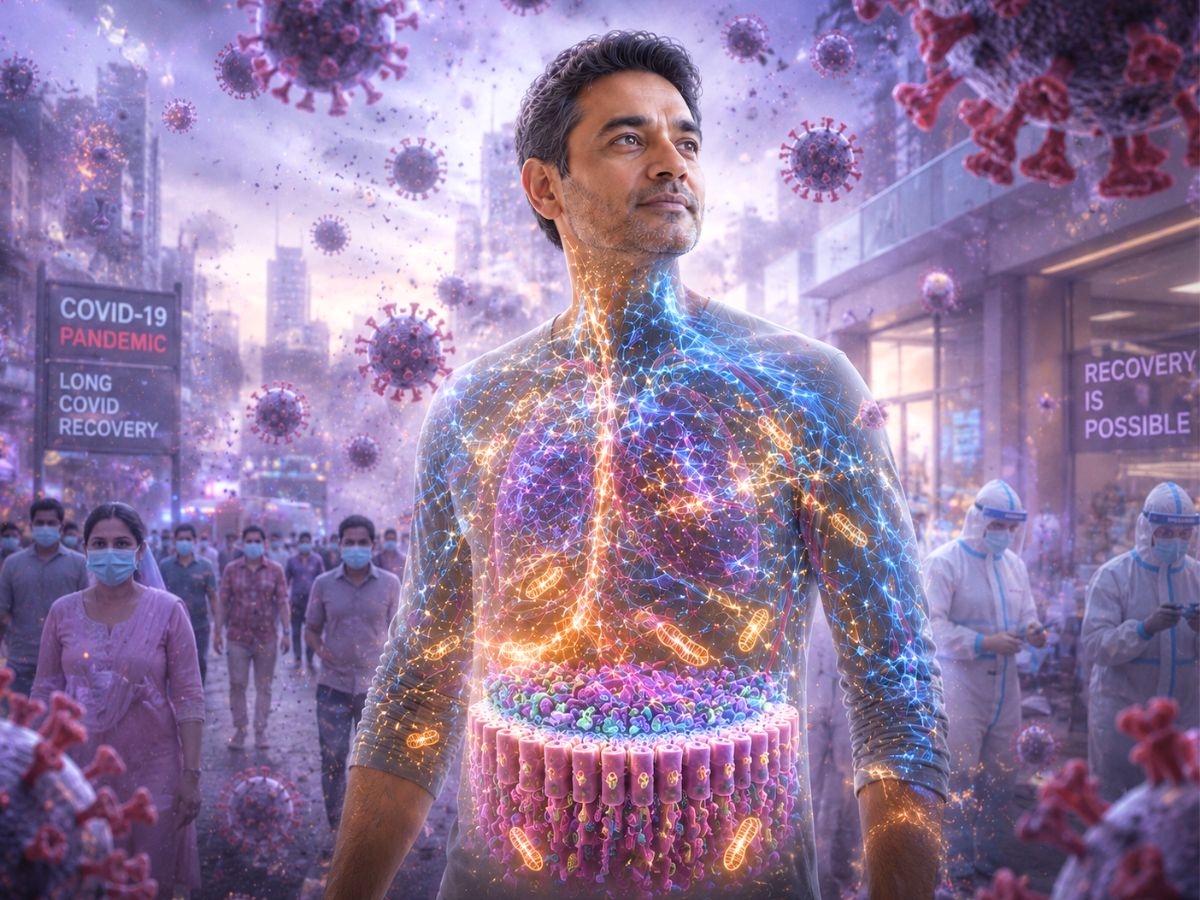
For the significant population of Indians who had COVID and never got back to baseline — a multi-system, physician-designed approach to the lingering biology of long COVID.
At a Glance
What it targets: The multi-system pattern of post-acute sequelae of SARS-CoV-2 infection — what most people call ‘long COVID’ or ‘post-COVID syndrome’. Persistent fatigue, post-exertional malaise, brain fog, dysautonomia, gut disruption, and sleep architecture loss that didn’t resolve when the acute illness did.
Who it’s for: Adults who had COVID (confirmed or strongly suspected) and have not returned to pre-COVID baseline months or years later — and whose conventional investigations have come back ‘normal’.
How it works: A synthesis protocol drawing on mitochondrial and energetic support, cognitive and nervous system regeneration, gut barrier and inflammation work, plus the lifestyle layer (especially pacing) that determines recovery trajectory.
What to expect: Recovery is non-linear. Improvement in one or two systems often precedes broader function returning. ALIV does not guarantee specific outcomes.
Who This Protocol Is For
There is a specific, increasingly common experience in Indian clinics: a patient in their 30s, 40s, or 50s, previously healthy, who tells their doctor they have never felt the same since they had COVID. Energy never came back. Workouts that were routine now produce days of payback. Cognitive stamina is reduced. Sleep is disturbed. Gut function changed. Conventional investigations come back largely normal — but the person knows they’re different. Many of our clients arrive specifically researching long COVID treatment, post-COVID brain fog, post-COVID fatigue, post-exertional malaise, dysautonomia, or how to recover from long COVID in India — and want a multi-system integrative approach.
This is long COVID — what research calls post-acute sequelae of SARS-CoV-2, or PASC. Indian research has shown long COVID prevalence ranging from approximately 37% in a Haryana cohort to nearly 40% in North Indian populations, with neuropsychiatric features persisting up to 2.5 years post-infection in 2025 NIMS/Northwestern research. Integrative care pathways remain rare in India.
This protocol was built for you if:
- You had COVID (confirmed or strongly suspected) and your baseline energy, function, or cognition has never fully returned
- You experience post-exertional malaise — exercise produces a delayed ‘crash’ that lasts days
- Brain fog, word-finding difficulty, reduced cognitive stamina, or memory changes that appeared or worsened after COVID
- Dysautonomia symptoms — palpitations, dizziness on standing, temperature dysregulation, new exercise intolerance
- Gut changes that began with or after COVID — new food sensitivities, altered bowel patterns, chronic bloating
- Sleep architecture disruption that appeared post-COVID and hasn’t resolved
- Your investigations are ‘normal’ but you know something is different
How It Works — The ALIV Approach
Long COVID is not one illness. Research increasingly characterises it as a syndrome with multiple overlapping phenotypes — fatigue/PEM dominant, cognitive/neurological dominant, dysautonomia dominant, gut-and-immune dominant, sleep architecture dominant. Most clients have features across several. The protocol is built around this heterogeneity.
Layer 1 — Mitochondrial and Energetic Support
Persistent fatigue and post-exertional malaise are among the most common and disabling long-COVID features. Mitochondrial dysfunction is a core driver — reduced ATP production, oxidative stress, impaired energy recovery. ALIV’s Layer 1 uses targeted IV therapy (Myer’s + NAD+ Vitality) to restore mitochondrial cofactors. NAD+ is depleted in inflammatory states and central to SIRT1/mitochondrial function. Where mitochondrial dysfunction is prominent, SS-31 (Elamipretide) can be added — it binds cardiolipin in the mitochondrial inner membrane, reducing ROS at the source. Thymosin Alpha-1 is layered in for the immune dysregulation underlying post-viral fatigue.
Layer 2 — Cognitive and Neurological Support
Brain fog, cognitive stamina loss, and working memory changes are documented across Indian post-COVID cohorts, persisting years after acute infection. Mechanisms include neuroinflammation, vascular changes, and dysautonomia. This layer combines cognitive-supporting peptides (Semax and Selank, plus GHK-Cu where appropriate) with autonomic regulation work. Long COVID neurological recovery is variable and requires patience.
Layer 3 — Gut Barrier and Systemic Inflammation
Post-COVID gut changes are documented and biologically plausible — SARS-CoV-2 directly affects intestinal tissue via ACE2 receptors, and the AIIMS prospective cohort showed significant post-COVID functional GI disorders vs controls. Where gut symptoms are prominent, BPC-157 and Thymosin Alpha-1 are layered in to support mucosal repair and immune balance. The Gut Barrier Protocol coordinates with this layer.
Layer 4 — Diagnostic Precision
Your ALIV physician runs a comprehensive workup specifically for long-COVID phenotyping: detailed history of acute illness and post-COVID symptom evolution; inflammatory markers (hsCRP, ESR, ferritin); micronutrient status (D, B12, ferritin, magnesium); autonomic assessment; and screening for post-COVID red flags requiring specialist referral: persistent chest pain, exertional syncope, significant breathlessness, or signs of myocarditis or pulmonary fibrosis.
What to Expect
Long-COVID recovery is genuinely different from other protocols. It is not linear. Clients often improve in some systems before others, experience setbacks (especially around exertion or stress), and recover at very different rates.
Phase | What You May Notice |
Early phase | Sleep often shifts first. Some clients notice cognitive clarity improving before energy. Pacing becomes more effective. |
Building phase | Energy capacity gradually expands. PEM threshold rises. Cognitive stamina returns. Gut and autonomic features begin stabilising. |
Sustained phase | Function continues to broaden. The protocol shifts toward maintenance with the lifestyle layer carrying most of the work. |
Long-COVID recovery is highly variable between individuals. Some clients experience dramatic improvement; others recover partially; a small group has persistent features despite all interventions. ALIV does not guarantee specific outcomes.
What’s Involved
Before starting, your ALIV medical team runs the diagnostic assessment described above. Post-COVID red flags route to specialist care first. Contraindications detailed in the FAQ below.
The Lifestyle Layer — Non-Negotiable in Long COVID Recovery
In long-COVID recovery, lifestyle factors are arguably more consequential than in any other protocol. Ignoring the lifestyle layer reliably stalls progress.
Pacing — the most important concept: post-exertional malaise is real, measurable, and must be respected. Pushing through PEM does not build capacity — it sets recovery back. Pacing means matching activity to your current energy envelope, expanding it gradually, accepting that ambition during a low-energy day costs you days. Your ALIV physician helps you build a pacing structure suited to your phenotype.
Sleep, nutrition, reinfection, nervous system: sleep is where post-viral recovery actually happens; the Sleep Protocol coordinates. Nutrition: adequate protein, anti-inflammatory pattern, targeted supplementation (Magnesium, Omega-3, Vitamin D, B-vitamins). Reinfection prevention: each COVID reinfection risks setback — vaccination individualised, mask use in high-risk settings sensible. Nervous system: breathwork, meditation, parasympathetic-supporting practices where dysautonomia is part of the picture.
Frequently Asked Questions
How do I know if I have long COVID?
The working clinical definition is symptoms that began with or after COVID, persist beyond 3 months, and aren’t explained by another diagnosis. Common features: persistent fatigue, post-exertional malaise, brain fog, dysautonomia, gut changes, sleep disruption. Diagnosis is clinical — there’s no single test.
Can long COVID be cured?
Honest answer: there is no guaranteed cure. What is achievable for many clients is meaningful recovery over months to a few years — reduced fatigue and PEM, improved cognition, better autonomic regulation, restored gut function, gradual return of exercise tolerance. Some reach near-baseline; some recover partially; a minority have persistent features. Earlier intervention, better trajectory. Pushing-based recovery worsens long COVID.
What if I’m not sure I had COVID?
Many Indians had COVID without formal diagnosis — especially during early waves when testing was limited. The protocol applies to clients with a strong clinical history of post-viral symptom onset even without confirmed test results.
Why isn’t my regular doctor treating this?
Long COVID presents in ways that don’t fit single-specialty care. Cardiology investigates the palpitations, neurology the brain fog, gastroenterology the gut — each reports ‘normal’ within their domain. Long COVID is multi-system and needs integrative management alongside specialist coordination where indicated.
How long will recovery take?
It varies enormously. Some clients see meaningful change within months; others require longer time horizons. A minority have persistent features. The protocol is structured for sustained engagement.
Is this evidence-based?
Long COVID is an actively evolving research field. The interventions used (peptide therapies, NAD+, mitochondrial support, pacing) have evidence bases for the mechanisms they target. Long-COVID-specific RCT evidence is limited globally. Use at ALIV is integrative, physician-supervised, and grounded in current understanding.
Who should NOT do this protocol?
Anyone with acute or unstable COVID sequelae requiring hospital care; significant untreated post-COVID cardiac complications (e.g. myocarditis); pulmonary fibrosis requiring pulmonology management; pregnancy or breastfeeding; clients seeking to bypass appropriate specialist evaluation.
Take the Next Step
If you had COVID and never got back to who you were — and conventional investigations haven’t explained why — you are not imagining it.
To find out if the Post-COVID / Long COVID Recovery Protocol is right for you, speak with our medical team:
- Pune (Bund Garden): +91 77199 88811
- Mumbai (Khar West): +91 98220 93069
Or book a consultation through alivtherapy.in.
Research References
1. Singh AK, Kumar K, Singh M, et al. Neuropsychiatric manifestations of Long COVID in India: a persistent problem 2.5 years after disease onset. Front Neurol. 2025;16:1704801. PMID: 41312347
2. Salve HR, Daniel RA, Kumar A, Kumar R, Misra P. Prevalence and determinants of long COVID among patients attending the outpatient department of a subdistrict hospital in Haryana. Cureus. 2023;15(9):e46007. DOI: 10.7759/cureus.46007
3. Golla R, Vuyyuru S, Kante B, et al. Long-term gastrointestinal sequelae following COVID-19: a prospective follow-up cohort study. Clin Gastroenterol Hepatol. 2023;21(3):789-796. PMID: 36273799
4. Jain N, Shah K, Chauhan R, et al. Mapping of long COVID condition in India: a study protocol for systematic review and meta-analysis. Front Rehabil Sci. 2025;6:1419963. DOI: 10.3389/fresc.2025.1419963
5. Kumar VJ, Koshy JM, Divyashree S, et al. Prevalence and predictors of long COVID at 1 year in a cohort of hospitalized patients: a multicentric qualitative and quantitative study. PLoS One. 2025;20(4):e0320643. DOI: 10.1371/journal.pone.0320643
6. Birk AV, Liu S, Soong Y, et al. The mitochondrial-targeted compound SS-31 re-energizes ischemic mitochondria by interacting with cardiolipin. J Am Soc Nephrol. 2013;24(8):1250-1261. PMID: 23813215
Disclaimer
The information on this page is for educational purposes only and is not intended as medical advice. ALIV therapies are not intended to diagnose, treat, cure, or prevent any disease, including long COVID or post-acute sequelae of SARS-CoV-2. This protocol is integrative supportive care, not a replacement for specialist management of post-COVID cardiac, pulmonary, or other organ-specific complications. Outcomes vary significantly between individuals — long COVID is heterogeneous, and ALIV does not guarantee specific outcomes. Peptide therapies referenced (Thymosin Alpha-1, SS-31, BPC-157, Semax, Selank, GHK-Cu) are not FDA-approved and are accessed via compounding pharmacies; informed consent and physician monitoring are essential. Please consult a qualified healthcare professional before starting any therapy programme.