Collagen Supplements vs IV Therapy for Skin: What the Evidence Shows | ALIV
June 15, 2026

Collagen supplements have colonised Indian pharmacies, supermarkets, and Instagram feeds — collagen powders, drinks, gummies, and capsules claiming to restore skin firmness, reduce wrinkles, and reverse ageing. At the same time, IV vitamin C is marketed as a collagen-boosting therapy. Understanding which route is appropriate for your specific skin goal helps patients spend both money and expectations more wisely.
How Collagen Works in Skin
Collagen is the structural protein providing skin its firmness, elasticity, and wound-healing capacity, produced by fibroblasts in the dermis. Collagen production declines from the mid-20s, falling by roughly 1-1.5% per year. By the late 40s, the cumulative effect is visible: skin that was firm becomes thinner, more lax, and slower to heal. The mechanism by which any supplement or IV therapy could improve this is worth examining honestly — because oral collagen and IV vitamin C work through completely different mechanisms.
Oral Collagen Supplements: What Research Shows
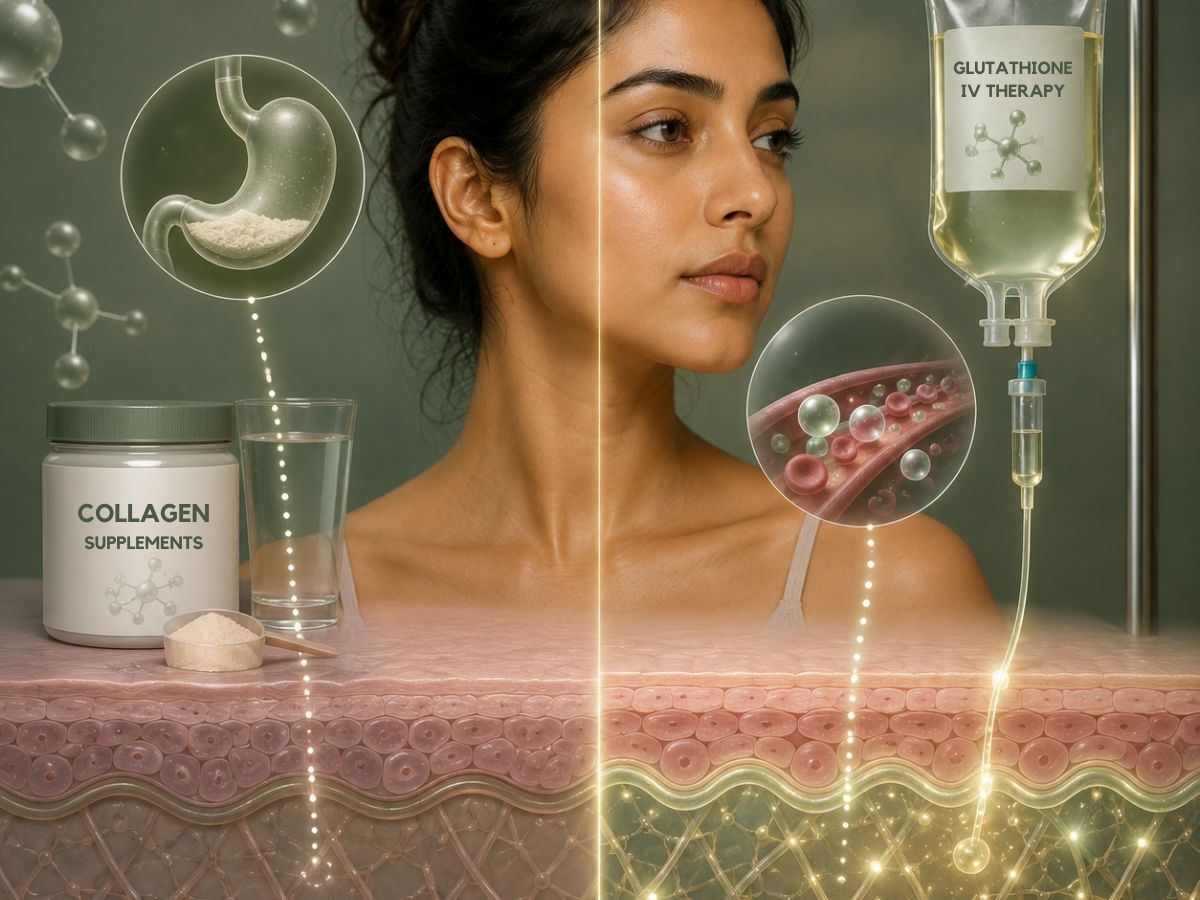
When you eat collagen, your digestive system breaks it down into amino acids and small peptides. Specific collagen tripeptides from hydrolysed collagen have been shown in studies to accumulate in the dermis and stimulate fibroblast collagen synthesis — a result initially counterintuitive to many researchers who assumed complete digestion would eliminate specific collagen activity.
Clinical evidence for hydrolysed collagen supplementation at 2.5-10g per day is genuinely positive: a 2019 systematic review in the Journal of Drugs in Dermatology found significant improvements in skin elasticity, hydration, and wrinkle appearance in multiple randomised controlled trials. The effect size is modest but real. The limitation: collagen supplements support existing fibroblast activity but cannot override age-related fibroblast decline, UV damage, or smoking — the dominant drivers of collagen loss.
IV Vitamin C: A Different Collagen Mechanism
IV vitamin C does not contain or deliver collagen. Its collagen-relevant mechanism is indirect: vitamin C is an essential cofactor in the hydroxylation of proline and lysine — the amino acids that must be modified before collagen triple helices can form and stabilise. Without adequate vitamin C, fibroblasts cannot synthesise collagen correctly. At supraphysiological plasma concentrations achieved by IV delivery, vitamin C maximally supports fibroblast collagen synthesis and simultaneously provides antioxidant protection against UV-driven oxidative degradation of existing collagen.
The case for IV vitamin C is strongest for patients who want to push beyond oral absorption limits — relevant for anti-ageing applications where maximum collagen synthesis support is the goal. Full bioavailability comparison: vitamin C oral vs IV vs topical.
The Most Rational Clinical Approach
Rather than treating oral collagen and IV vitamin C as alternatives, they are best understood as complementary. Oral hydrolysed collagen provides the amino acid building blocks — the raw materials fibroblasts use to make collagen. IV vitamin C provides the enzymatic cofactor without which fibroblasts cannot assemble those materials into functional collagen. Together, they address both sides of the collagen synthesis equation.
Which collagen supplement form is most effective?
Hydrolysed marine collagen and hydrolysed bovine collagen peptides (types I and III) are the forms with the strongest clinical evidence for skin. Dose matters: 2.5-10g per day is the range studied in clinical trials. Collagen gummies and drinks with 500-1,000mg are likely underdosed for meaningful skin effects. "Plant collagen" supplements contain collagen precursors (amino acids and vitamin C) rather than collagen itself — useful but requires honest labelling.
Do collagen supplements work for everyone?
Collagen supplement evidence shows average improvements across study populations — individual response varies with age, existing collagen reserves, dietary protein intake, UV damage history, and whether collagen-depleting factors (smoking, significant stress, poor sleep) are present. Younger patients with less accumulated collagen loss may notice more obvious responses; older patients with more established deficit may see more modest effects from supplementation alone.
Can I take collagen supplements and receive IV therapy simultaneously?
Yes — they complement rather than duplicate each other. Continuing oral hydrolysed collagen alongside an IV vitamin C programme addresses both the raw material and the enzymatic cofactor side of collagen synthesis simultaneously. There is no interaction between them that would make combining them inadvisable.
Is there any downside to long-term collagen supplementation?
Generally well-tolerated at recommended doses. Individuals with seafood allergies should verify the source of marine collagen. High-protein diets combined with collagen supplementation should be considered in the context of overall protein intake goals. No established toxicity concern with long-term use at 2.5-10g per day in healthy adults.
Does retinol work better than collagen supplements for anti-ageing?
Retinol has a stronger evidence base for topical collagen stimulation than oral collagen — it directly stimulates fibroblast activity and inhibits the MMPs (matrix metalloproteinases) that degrade existing collagen. Retinol and oral collagen are complementary, not competing. The optimal anti-ageing approach typically combines topical retinoid at night, oral collagen supplement, vitamin C serum in the morning, and broad-spectrum SPF — with IV vitamin C as a periodic intensity boost.