Who Is an Ideal Candidate for ACT in Pune & Mumbai? | ALIV
March 25, 2026

Regenerative Medicine | 10 min read | ALIV Therapy — Pune & Mumbai
Who Is an Ideal Candidate for Autologous Cell Therapy (ACT)?
One of the most important conversations at any regenerative medicine clinic is one that often does not happen: the honest conversation about who cell therapy is actually right for — and who it is not.
At ALIV Therapy's clinics in Pune and Mumbai, autologous cell therapy eligibility is assessed through a structured clinical process — not assumed from a condition name or a patient's enthusiasm. This matters because cell therapy is not a universal solution. It works profoundly well for the right patient in the right circumstances, and it delivers limited benefit — or is genuinely unsuitable — for others.
This guide explains, condition by condition and criterion by criterion, exactly who is a good candidate for autologous cell therapy in Pune and Mumbai — including what strengthens candidacy, what weakens it, and what makes someone unsuitable entirely. If you or a family member is considering ACT, this is the most important thing to read before booking a consultation.
1. The Foundational Principle — Why Candidacy Assessment Is Non-Negotiable
Autologous cell therapy works by reintroducing the patient's own regenerative cells into a damaged biological environment — to reduce inflammation, support tissue repair, and restore function. For this to be clinically meaningful, two things must be true:
• There must be enough residual biological tissue or cell reserve for the therapy to work with — bone marrow, adipose tissue, and functional tissue at the treatment site
• The patient's overall health must be sufficient to tolerate the cell extraction procedure and allow the reintroduced cells to function in the intended environment
When these conditions are not met, cell therapy is not simply less effective — it is genuinely not appropriate. This is why ACT candidacy criteria in India are assessed through clinical evaluation, not online self-assessment. No blog — including this one — replaces a consultation with ALIV Therapy's medical team.
2. The Universal Candidacy Framework — Six Key Factors
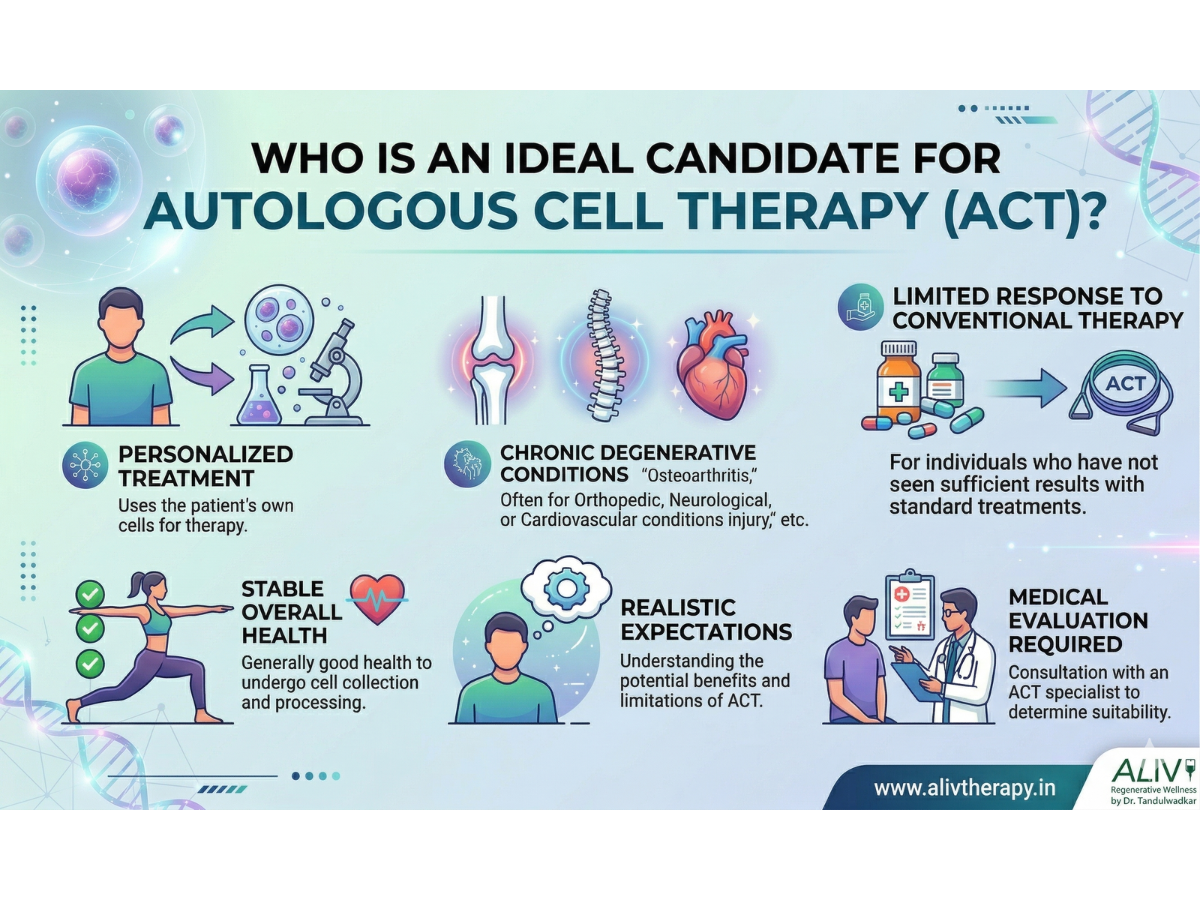
Regardless of the specific condition being treated, ALIV Therapy's candidacy assessment covers six core factors. Understanding these helps patients in Pune and Mumbai arrive at their consultation with realistic expectations:
3. Condition-by-Condition Candidacy — The Full ALIV Matrix
The following matrix maps ideal ACT candidate profiles in Pune and Mumbai condition by condition — based on ALIV Therapy's clinical protocols and the evidence base for each indication.
4. The Role of Disease Stage — Why 'Earlier Is Stronger'
The single most consistent finding across all cell therapy patient profiles in India is the relationship between disease stage and outcome. Earlier-stage disease — where the biological environment still has working tissue, functional cells, and regenerative capacity — responds more strongly to autologous cell therapy than advanced disease where extensive damage has already occurred.
Here is the clinical logic:
• In early osteoarthritis, the joint still has cartilage that can be supported. In Grade 4 OA with bone-on-bone contact, there is no cartilage substrate for regeneration to work with.
• In early Parkinson's, dopaminergic neurons are declining but still present. The therapy slows their loss. In end-stage Parkinson's, the neuronal population is so depleted that neuroprotective therapy has little left to protect.
• In early-to-mid Type 2 diabetes, beta cells are stressed but functional. The therapy supports their recovery. In complete beta cell failure, there is no cellular function for the therapy to amplify.
The practical implication for patients in Pune and Mumbai: if you are considering autologous cell therapy, the best time to explore it is before your condition has progressed to its most severe stage — not as a last resort after everything else has failed. Waiting until the final stage of a disease substantially reduces the clinical case for ACT.
5. Age — A Factor, Not a Barrier
A common concern among patients in Pune and Mumbai is whether age disqualifies them from autologous cell therapy eligibility in India. The honest answer: age is a factor — but not a disqualifier in most cases.
The quantity and quality of regenerative cells in bone marrow and adipose tissue does decrease with age. This is a biological reality. However, adipose tissue in particular — one of ALIV Therapy's primary cell sources — maintains a substantial regenerative cell population well into later life.
Many of ALIV Therapy's most clinically meaningful outcomes have been achieved in patients in their 60s, 70s, and beyond. Age is assessed as part of the overall candidacy picture — alongside disease stage, general health, tissue quality, and realistic outcome goals — not as a standalone disqualifier.
6. When Cell Therapy Is Not Appropriate — What ALIV Tells You Directly
A hallmark of a responsible regenerative medicine consultation in Pune and Mumbai is that the clinic communicates clearly when cell therapy is not appropriate — not just when it is. At ALIV Therapy, the following factors lead to a direct conversation about alternative or complementary approaches:
• Active systemic infection — introducing regenerative cells into an infected biological environment risks spreading the infection and reduces therapeutic effect
• Active malignancy — cell therapy is contraindicated in patients with active cancer, as cellular proliferation signals could theoretically interact with tumour biology
• Severe anaemia or blood disorders — certain haematological conditions affect the quality and safety of cell extraction procedures
• Very advanced, end-stage disease — where the biological substrate is insufficient for meaningful therapeutic effect; surgery or other approaches may be more appropriate
• Unrealistic outcome expectations — if a patient expects a guaranteed cure or complete reversal of long-standing advanced disease, ALIV Therapy's team has an honest conversation about what is and is not achievable before any protocol is recommended
This transparency is not a limitation of ALIV Therapy — it is its defining clinical strength. A clinic that recommends cell therapy for everyone who walks through the door is not practising personalised regenerative medicine in Pune and Mumbai. It is practising commerce.
7. What the Assessment at ALIV Therapy Looks Like
For patients in Pune and Mumbai, the autologous cell therapy assessment at ALIV Therapy covers:
1. Full review of medical history, current diagnosis, and disease progression timeline
2. Assessment of existing imaging (X-rays, MRIs, scans) relevant to the condition being considered
3. Review of current medications, ongoing therapies, and previous treatment history
4. Evaluation of biological markers relevant to the condition — HbA1c for diabetes, inflammatory markers for autoimmune conditions, motor assessment scores for neurological conditions
5. Discussion of realistic outcomes based on disease stage, patient age, and condition-specific evidence — including what is and is not achievable
6. Informed consent — ensuring the patient fully understands the experimental nature of these therapies and the range of possible outcomes before any protocol is agreed
Frequently Asked Questions
Who is a good candidate for autologous cell therapy in Pune?
Good candidates for autologous cell therapy in Pune at ALIV Therapy are adults with mild-to-moderate chronic conditions who have not responded adequately to conventional treatment, retain biological tissue reserve, are in adequate general health for cell extraction, and have realistic outcome goals. A clinical assessment is always the essential first step.
Who is a good candidate for autologous cell therapy in Mumbai?
The same candidacy criteria apply at ALIV Therapy's Mumbai clinic. Adults with mild-to-moderate disease in Mumbai who have plateaued on conventional treatment and are seeking a clinically supported next step — with honest outcome expectations — are typically assessed as strong candidates.
What conditions does ALIV Therapy treat with autologous cell therapy?
ALIV Therapy in Pune and Mumbai offers ACT for: osteoarthritis, rheumatoid arthritis, Type 2 diabetes, Parkinson's disease, Alzheimer's disease, Crohn's disease, ulcerative colitis, stroke-induced paralysis, spinal cord injury, COPD, infertility, and erectile dysfunction. Each condition is individually assessed before any protocol is recommended.
What disqualifies someone from autologous cell therapy?
Factors that may disqualify a patient include: active systemic infection, active malignancy, severe anaemia or blood disorders, very advanced end-stage disease with near-complete tissue loss, and expectations of a guaranteed cure. All of these are assessed at ALIV Therapy's clinical consultation — no protocol is recommended without a full evaluation.
Is age a factor in ACT candidacy in Pune and Mumbai?
Age is a factor in ACT candidacy in Pune and Mumbai but not a disqualifier. Cell yield from adipose tissue remains substantial well into later life. ALIV Therapy assesses each patient's biological profile — not age alone. Many patients in their 60s, 70s, and beyond have achieved meaningful clinical outcomes through autologous cell therapy.
How do I know if I am suitable for autologous cell therapy in Pune or Mumbai?
The only reliable way to determine suitability is through a clinical assessment at ALIV Therapy — covering your diagnosis, disease stage, medical history, current medications, imaging, and relevant biomarkers. No online resource replaces this assessment. Book at alivtherapy.in/contact.
Can autologous cell therapy help if conventional treatment has failed?
Yes — inadequate response to conventional treatment is one of the strongest indicators of ACT candidacy. Patients who have not responded adequately to physiotherapy, medication, steroid injections, or biologics — and still retain sufficient biological tissue reserve — are typically among the best candidates for autologous cell therapy at ALIV Therapy in Pune and Mumbai.
What is the difference between a good and poor ACT candidate?
A good ACT candidate has mild-to-moderate disease (not end-stage), retains functional tissue reserve, has realistic improvement goals (not guaranteed cure expectations), is in adequate general health for cell extraction, and is committed to complementary physiotherapy and lifestyle management. A poor candidate typically has very advanced end-stage disease, active infections or malignancy, blood disorders affecting cell extraction safety, or unrealistic expectations that no responsible clinic can meet.
Find Out If ACT Is Right for You — Book Your Assessment in Pune or Mumbai
The only way to know definitively whether autologous cell therapy is appropriate for your specific condition, stage, and health profile is through a clinical assessment with ALIV Therapy's medical team. Not a blog, not an online quiz — a conversation with a qualified clinician who will give you an honest answer, whether that answer is yes, no, or not yet.
Explore ALIV Therapy's autologous cell therapy protocols:
• Autologous Cell Therapy — All Conditions Overview — alivtherapy.in/therapy/autologous-cell-therapy
• Cell Therapy for Osteoarthritis Pune & Mumbai — alivtherapy.in/therapy/autologous-cell-therapy/osteoarthritis
• Cell Therapy for Type 2 Diabetes Pune & Mumbai — alivtherapy.in/therapy/autologous-cell-therapy/diabetes-type-2
• Cell Therapy for Parkinson's Disease — alivtherapy.in/therapy/autologous-cell-therapy/parkinsons-disease
Medical Disclaimer
The content of this article is for informational purposes only and does not constitute medical advice. Therapies offered by ALIV are proprietary, experimental protocols and results vary by individual. Always consult a qualified medical professional before commencing any therapy. ALIV Therapy is operated by Alreschaa Life Sciences LLP.